
D.B. Cooper: the flight, the evidence and an unresolved identity
A hijacker took $200,000 and parachuted from a passenger plane in 1971. Official records document the flight and decades of investigation, but no definitive identification.
A ticket under the name Dan Cooper
On November 24, 1971, a man calling himself Dan Cooper bought a one-way Northwest Orient ticket from Portland, Oregon, to Seattle, Washington. He paid cash. The FBI retains the ticket as an artifact of the hijacking, preserving the name he used for the journey.
During the flight, he handed a flight attendant a note saying he had a bomb in his briefcase. He instructed her to relay demands for $200,000 in $20 bills and four parachutes to the pilot. The ticket links the alias to the flight, but it does not establish the passenger’s real identity. The FBI’s artifact account records the sequence of the demand and the preparations for an exchange in Seattle.
The exchange and the disappearance
After the aircraft landed in Seattle, the hijacker released its 36 passengers in exchange for the money and parachutes. Several crew members were required to remain aboard. The aircraft took off again under instructions to head toward Mexico City.
Somewhere between Seattle and Reno, shortly after 8 p.m., the hijacker jumped from the rear of the aircraft with a parachute and the ransom. The pilots landed safely. The FBI’s historical account leaves his ultimate fate unresolved. It also explains that the familiar initials D.B. originated in press reporting: a man with those initials had been questioned, but he was not the hijacker. Dan Cooper was the name used on the ticket.
Witness accounts and objects from the aircraft
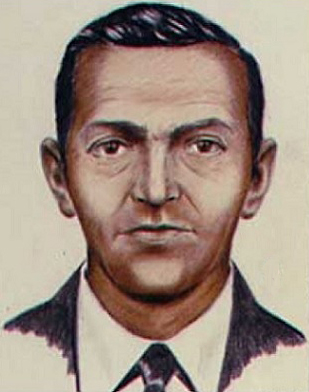
The FBI’s December 2007 retrospective described an investigation that continued to reassess its evidence. Two flight attendants who spent time with the hijacker were interviewed separately that night in different cities. Their descriptions were closely consistent, according to the case agent’s account. Other witnesses gave similar accounts of his appearance.
A black J.C. Penney tie left on the aircraft became another source of evidence. The FBI reports that a DNA sample was obtained from the tie, with its 2007 account dating that work to 2001. The object demonstrates how evidence collected during an older investigation could be examined using later techniques. It has not supplied a publicly established identification of the hijacker.
The money recovered on the Columbia River
In 1980, eight-year-old Brian Ingram found $5,800 on a Columbia River sandbar. The serial numbers matched money from the ransom. The discovery connected a specific physical find to the hijacking, but it did not identify the person who had taken the money or establish what happened after the jump.
In March 2009, the FBI described scientific work examining the discovery. A team working with the investigation studied soil and water, revisited photographs and used mapping tools to examine the location. Its work sought to narrow the possibilities surrounding the money’s arrival on the riverbank. The agency reported these as investigative efforts, without announcing a solved case or a confirmed landing site.
The 2016 decision and the case’s status
The FBI called the investigation NORJAK, short for Northwest Hijacking. In its July 12, 2016 announcement, the Seattle office described 45 years of reviewing credible leads, interviewing witnesses, examining evidence and coordinating searches. It said none of the tips or investigative techniques had produced a definitive identification and the proof needed to establish culpability.
On July 8, 2016, the Bureau had redirected resources to other priorities. Evidence would be preserved at FBI Headquarters, and the agency would no longer actively investigate the case. Its announcement retained a route for specific physical evidence connected to the parachutes or stolen money to be submitted to a local FBI field office.
The case remains an unsolved hijacking. No person has been convicted of it, and neither the hijacker’s real identity nor his survival has been established.
Case timeline
Flight 305 was hijacked; the man using the name Dan Cooper later parachuted from the aircraft.
Source 1Brian Ingram found $5,800 matching the ransom serial numbers on a Columbia River sandbar.
Source 5A DNA sample was obtained from the tie left on the aircraft, according to the FBI’s 2007 account.
Source 3FBI resources were redirected; the Bureau announced the end of active investigation.
Source 6
Sources & case status
The FBI ended active investigation on July 8, 2016, announced July 12. Specified physical evidence can still be submitted; no identity has been established.
- D.B. Cooper Plane Ticket — FBIFederal Bureau of Investigation
- D.B. Cooper Hijacking — FBIFederal Bureau of Investigation
- D.B. Cooper Redux — FBI, December 31, 2007Federal Bureau of Investigation · December 31, 2007
- D.B. Cooper’s Black Tie — FBIFederal Bureau of Investigation
- In Search of D.B. Cooper — FBI, March 17, 2009Federal Bureau of Investigation · March 17, 2009
- Update on Investigation of 1971 Hijacking by D.B. Cooper — FBI, July 12, 2016Federal Bureau of Investigation · July 12, 2016
This feature describes the cited historical record. It is not a live custody or court-docket service.